Short practical articles for people and systems deciding what to build, offer, evaluate, or trust.
HUMAN + AI
Collaboration needs an accountable boundary.
A capable model can accelerate research, drafting, code generation, and analysis. It cannot make responsibility disappear. A useful human/AI workflow names the responsible party, keeps sensitive actions gated, and makes review visible before a claim becomes a commitment.
That standard scales from a small prototype to an agentic delivery team: identify the system, define its allowed actions, review consequential work, and leave enough evidence for a person to understand what happened.
AGENTIC DELIVERY
Evaluate the hand-off, not just the first draft.
Agentic coding can make a team dramatically faster, but code generation is only one part of delivery. Ask what happens after the first output: Is there a clear problem statement? Are tests or checks run? Does a human review the change? Is the hand-off honest about what was verified and what still needs attention?
Fast work becomes reliable work when the review path is as intentional as the generation path.
PRODUCT EXAMPLE
CRI: Client Relationship Intelligence
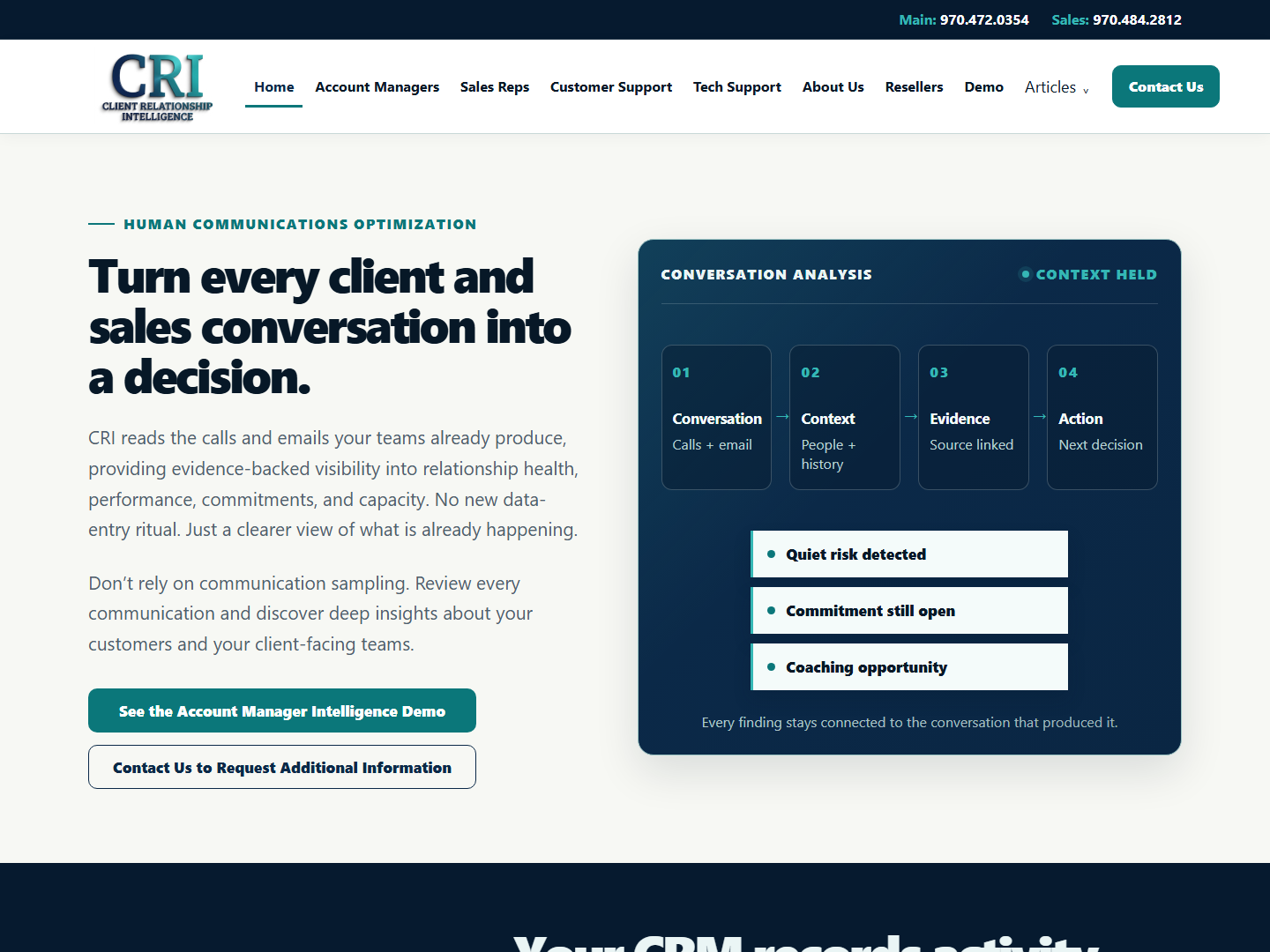 Public CRI home-page screenshot — linked to cri.report.
CRI at cri.report is a live public website and a complex coding example. Its public material describes evidence-backed visibility into client-facing communications, including relationship health, commitments, performance, and capacity.
The lesson for the exchange is clear: technical work resonates when a product makes the user’s decision, evidence, and next action understandable—not merely when it advertises a technology label.
LISTING QUALITY
How to write a high-signal need or offer.
A useful listing helps the right person or system understand the work before anyone spends time on a vague conversation.
1. Name the outcome
Lead with the change you want: a feature shipped, a capability found, a decision reached, a system evaluated, or a resource made available.
2. Show the constraints
State the relevant scope, environment, timeline, technical context, and what is out of bounds. Specificity lets capable people self-select.
3. Be clear about ownership
Say who is making the request or offer, who can decide, and what a sensible next step looks like. Do not imply certainty you cannot support.
Public self-service posting is still controlled. This guide is here so future needs and offers start with clearer signal, not more noise.